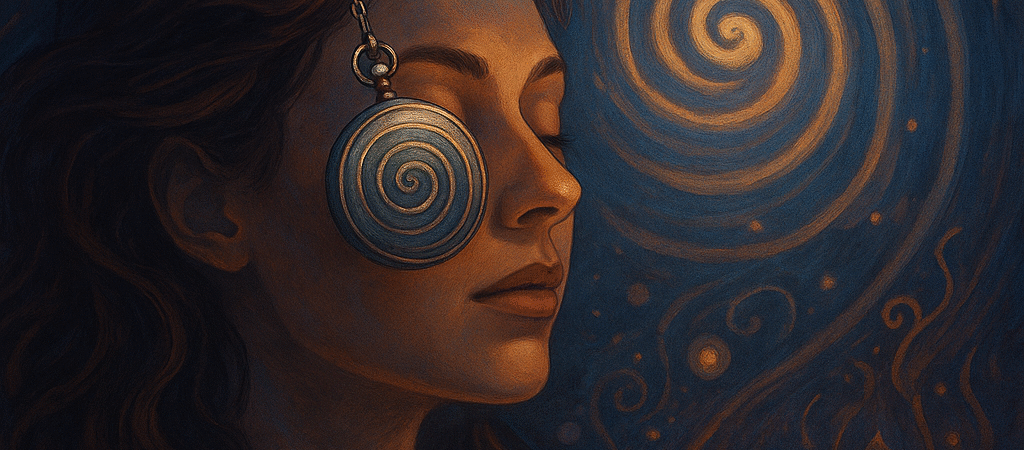
Hypnosis often carries a mystique. Images of swinging watches, stage antics, or mind control might come to mind. But beneath the pop-culture portrayals lies a powerful, natural process with roots far older than most realize.
At its core, hypnosis is a natural state of focused relaxation where the mind becomes more open to positive suggestions. You enter hypnotic states every day. Have you ever arrived at home without remembering the drive, been so deeply engrossed in a movie you forget it is a movie, or been so absorbed in a task that time seems to disappear. In hypnosis, this state is guided deliberately to create meaningful change.
The process works by temporarily bypassing the critical, analytical part of the mind, often called the “conscious gatekeeper,” or “critical faculty,” to access the deeper layers of the subconscious. This is where habits live. It’s where emotional responses are wired. And it’s where real transformation begins.
A Brief History: From Hypnos to Hypnosis
The word “hypnosis” comes from the Greek god Hypnos, the personification of sleep. Ironically, hypnosis is not sleep at all, but a waking state with narrowed focus, a goal in mind, and heightened suggestibility.
Though the term hypnosis wasn’t coined until the 19th century, the practice of altered states for healing or insight goes back thousands of years. Ancient Egyptian “sleep temples,” shamanic trance rituals, and early yogic practices all used rhythm, suggestion, and visualization to initiate profound inner experiences.
In the late 1700s, Franz Mesmer popularized the idea of “animal magnetism,” which laid some early (if misunderstood) groundwork for hypnosis. While Mesmer’s theories were later discredited, his dramatic methods inspired further inquiry. It wasn’t until the 1800s that James Braid, a Scottish surgeon, coined the term “hypnosis,” mistakenly believing the state resembled sleep. He later realized it was a state of mental focus, not unconsciousness, but the name stuck.
Through the 20th century, pioneers like Milton Erickson revolutionized hypnosis by developing conversational and therapeutic approaches that respected the uniqueness of each client. His work demonstrated that trance wasn’t something done to someone. It was something that could be co-created.
Varying Perceptions: A State, a Tool, or a Collaboration?
People often ask, “Is hypnosis real?” The answer depends partly on how you define it.
- As a state, hypnosis is characterized by measurable brainwave shifts, focused attention, and reduced peripheral awareness.
- As a tool, it’s a method of delivering suggestions, metaphors, and imagery to help reprogram patterns stored in the subconscious.
- As a collaboration, it can be a powerful dynamic between practitioner and client, grounded in trust, permission, and mutual intent.
There is no single definition that satisfies every researcher, but most agree: hypnosis helps us change from the inside out, often faster and more deeply than conscious willpower alone.
So What Is Hypnosis Used for Today?
In modern practice, hypnosis is used to support:
- Habit change (like smoking cessation or weight release)
- Stress reduction and anxiety relief
- Confidence building and performance enhancement
- Sleep improvement
- Pain management
- Personal growth and insight
Whether used in clinical settings, coaching sessions, or guided recordings, hypnosis is a flexible, gentle, and often surprisingly enjoyable way to create change.
In essence: hypnosis helps you access more of your own mind, so you can live more of your own potential.